For years, I’ve built products in secret. Outpost will be the first one I build in public.
That is a pretty big shift for me. My default move has always been to keep my head down, build quietly, polish the edges, squash most of the bugs, and only then invite people in. It’s a comfortable way to work. It also has a downside: by the time real feedback shows up, version 1 is already baked.
And baked software is a lot harder to reshape than cookie dough.
Part of the reason I’ve worked this way is simple. I never liked the idea of tipping my hand too early and handing competitors a free peek behind the curtain. For a small company, that can feel like a self-inflicted wound. But there’s another kind of wound too, building too long in private and finding out later that the thing people actually needed was one turn to the left.
So I’m trying something different.
Not because I feel perfectly comfortable about it. I don’t. Frankly, I’m a little nervous. But comfort is not always a great compass, and I’d rather learn earlier, while the product is still flexible, than unveil something polished and discover I got a few important things wrong.
That brings me to Outpost.
Outpost is a new product aimed at the decorator apparel world. The goal is to make it dramatically easier for shops to create and manage custom web stores for things like youth sports, school groups, clubs, fundraisers, and other limited-run sales with a clear ordering window before production begins. On the buyer side, it should feel simple and friction-light. On the shop side, it should feel manageable instead of like one more spinning plate.
If you’re not in decorator apparel, I still think this series will be worth following. The product is specific, but the questions behind it are not. How do you make good product decisions when time, money, and attention are all finite? How does a small company compete without turning into a bargain-bin copy of something bigger? How do you listen to feedback without letting the product become a committee project? Those are useful questions in just about any business.
This also marks the return of Bits & Grit. If you’ve followed Ministry of Bits for a while, you know I tend to spend more time building than broadcasting. Bits & Grit is where I’m changing that, a place to share the work, the decisions behind it, and the realities of building useful software as a small independent company.
Over the next two months, I’m going to share weekly updates here through Bits & Grit, along with shorter versions across social. This is not going to be a curated parade of polished wins. You’ll see decisions, tradeoffs, wrong turns, revisions, ideas that survive, and ideas that get quietly escorted to the exit.
That is part of the point.
I want this to be an honest look at what product development actually looks like when you’re building in the real world, with constraints, with uncertainty, and with people reacting to the work while it is still taking shape. Ideally it will be useful for people in this industry, useful for people outside it, and maybe even entertaining once in a while if I’m lucky and the software gods are unusually generous.
Next week, I’ll get into the first key decisions: what problem Outpost is trying to solve in version 1.0, what has already been cut or delayed, and where I think the real opportunity is. If you’re in decorator apparel, I’d especially like to hear your thoughts. If you’re not, questions are welcome too. Sometimes the best questions come from people who haven’t been trained to accept the industry’s weirdness as normal.
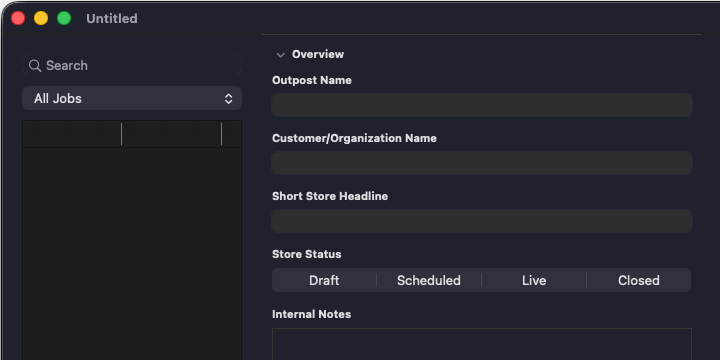
And because it would be rude to talk about all this without showing anything, I’m sharing the first very rough mockup.
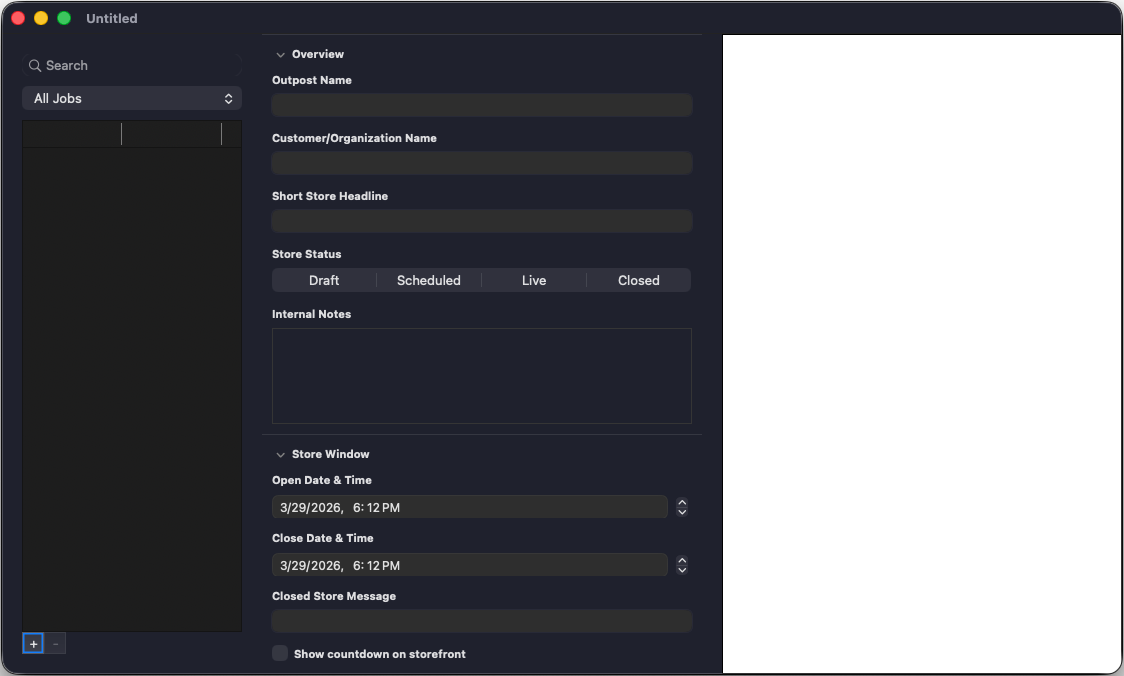
Very rough.
My natural instinct was to wait, clean it up, make it prettier, and attach a more polished explanation. Which is exactly why I’m showing it now instead. This is where the product actually is today, not where I wish it already were after two more rounds of fiddling.
The left third of the screen is the listing of stores, campaigns, limited-run sales, and so on. At the moment, I’m leaning toward calling each of these an “Outpost,” which is either nicely thematic or slightly awkward. The middle third is where you’ll configure and edit the selected Outpost. The right third is a simulated preview of what that Outpost will look like on the web.
So the rabbit is officially out of the hat. He looks like he just woke up after a long night on the town, has questions about management, and is not thrilled to be here.
What do you think?